


Experts in B2B and B2C SEO have distinct target markets and objectives. Consequently, they use distinct strategies. Although they have certain things in common, such as mobile optimization and quick page loads, they are very different from one another altogether. Professional B2B SEO services always prioritize producing high-quality content, regardless of your target demographic.
Any B2B or B2C agency’s internet marketing campaigns must include SEO. Despite using the SEO strategies (on-page, off-page, and technical SEO), B2B and B2C SEO approaches differ.
We’ll outline the main distinctions between B2B and B2C SEO services in this post so you can make sure the relevant people can reach your content.
What is B2B SEO
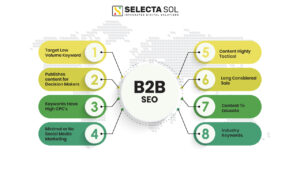
B2B search engine optimization (SEO) is a digital marketing tactic used to improve the ranking of B2B website pages in search engines such as Google and Bing. In contrast to B2C SEO, B2B SEO typically concentrates on keywords that important decision-makers in organizations look up while they’re at work.
In contrast to B2C, where customers purchase from businesses, B2B involves businesses purchasing from one another; nonetheless, the fundamentals of SEO are the same.
Those basics include:
- On-page SEO
- Off-page SEO
- Technical SEO
- Content
But there are specific challenges with B2B SEO. These also pertain to the target demographic for your marketing.
Individuals who purchase for a company are very different from those who purchase for themselves. As a result, B2B SEO services differ greatly from standard ones.
What is B2C SEO
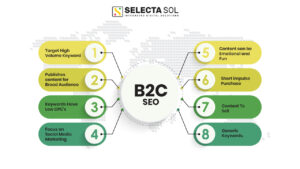
The focus of B2C SEO is on companies that offer goods or services directly to consumers. B2C campaigns improve your content and website to boost organic search engine rankings and traffic. The buyer path and target audience, however, differ from those of B2B SEO.
A B2C SEO plan that works:
- Builds brand awareness, authority, trust, and credibility.
- Increases online visibility and organic traffic.
- Boosts engagement across various marketing channels.
- Increases conversions and drives immediate sales.
- Generates positive product or service reviews.
- Establishes customer retention and loyalty.
Image
Difference between B2B & B2C SEO
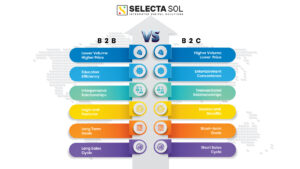
The difference between B2B SEO and B2C SEO is pivotal because it affects how your website ranks in the search engine results pages (SERPs). It also affects how potential customers buy your products or services.
B2B and B2C SEO campaigns aim to build brand awareness, generate sales, and increase revenue.
The critical difference between them include:
- The target audience
- The buying processes
- Length of the sales cycle
- Keyword and content strategy
- Key performance indicators (KPIs)
Let’s look closer at the top five B2B vs B2C SEO differences we think deserve your attention:
Audience Mindset difference between B2B and B2C
The target audience of B2B SEO services are the decision-makers of a company. These decision-makers handle all the business operations. They seek the best solutions to improve operations or solve specific challenges. They also value expert information and prioritize long-term professional relationships.
How to attract B2B consumers and optimize content for user intent:
- Create value-driven content that directly addresses the needs and challenges of a business.
- Incorporate relevant, targeted keywords that align with the search queries of decision-makers.
- Leverage multiple content types like blogs, whitepapers, and webinars that cater to varied information preferences of B2B audiences.
B2C target audiences are individual customers who are looking for products or services for their own use. They often make instant purchases. Their decision can be driven by emotion, personal benefits, and immediate needs or desires. They look for ease of use, convenience, overall experience, and relatable information.
How to attract B2C consumers and optimize content for user intent:
- Target relevant keywords and phrases for every stage of the sales funnel.
- Leverage social media marketing and email marketing.
- Create transactional and emotionally driven content to drive immediate sales.
Image
Content Strategy for B2B & B2C Businesses
B2B content marketing strategies deal with the needs, interests, and challenges of decision-makers of a company. Here, the goal of professional B2B SEO services is to offer solutions, establish authority, and build lasting relationships.
For instance, B2B SEO agencies can create informational and educational content that demonstrate thought leadership and expertise in the industry. They can use facts, statistics, case studies, and industry-related terminology.
B2B content examples:
- Informational blog posts
- Case studies
- White papers
B2C content marketing focuses on each customer’s unique demands, interests, and difficulties. This audience frequently consists of a sizable and varied group of people who are buying products for themselves or other people.
Although B2C content is informational, it is also more creative, transactional, and emotionally charged. It is a short-term approach to sales.
B2C content examples:
- Engaging blog posts
- Social media posts
- Promotional content
B2C vs B2B Sales Funnels
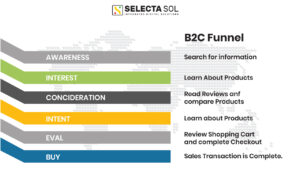
The B2B purchasing process is knowledge-driven and can take months to even years. There are numerous decision-makers and factors to take into account, the B2B buyer journey is lengthy and intricate.
According to Marketing Charts, it takes at least four months to close 74.6% of business-to-business transactions to new clients.
Compared to B2C sales, B2B purchases are riskier and more business-critical. Because of this, business-to-business (B2B) buyers usually make logical and analytical decisions.
Example B2B buying process factors include:
- Recognizing a problem or need.
- Evaluating and comparing available solutions.
- Defining the requirements for a product or service.
- Selecting a supplier and justifying the decision.
- Cost of the product or service.
The B2C buying process is emotionally driven and can take minutes or days.
The B2C buyer journey is also shorter and less complex than B2B. This is because one buyer is making the purchase decision.
Also, B2C buyers tend to make purchases based more on emotions or impulse than logic. In addition, the purchasing decision may involve less risk than a B2B sale.
Example B2C buying process factors include:
- Cost of the product or service.
- Product or service reviews.
- Urgency or limited-time offers.
- Sales or discounts.
- Brand reputation and credibility.
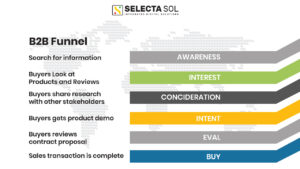
B2B Funnel
B2B vs B2C KPIs (Key performance indicators)
B2B SEO goals aim to establish brand authority, generate qualified leads, and build long-term relationships. Then, convert those leads into customers, drive revenue, and achieve a high ROI.
A B2B SEO campaign measures the success of these efforts with various key performance indicators. However, each business will track different metrics depending on their goals.
Example B2B KPIs include:
- Marketing Qualified Leads (MQLs): People who request more information about your product or service. These leads are more likely to become a customer than other leads.
- Customer Lifetime Value (CLV): The total revenue a B2B business generates from a customer over the entire relationship.
- Pipeline Velocity: The speed by which qualified leads move through a sales cycle.
- Lead Velocity Rate (LVR): The real-time growth of qualified leads month over month.
B2C SEO goals aim to raise brand awareness, attract organic traffic, drive immediate sales, and build brand loyalty. The objectives are to optimize for high-search-volume terms, enhance user engagement, and boost conversion rates.
A B2C SEO campaign measures the success of these efforts with tailored key performance indicators.
Example B2C KPIs include:
- Conversion Rate: The percentage of users who have completed a desired action on your website.
- Customer Acquisition Cost (CAC): The money spent on acquiring a new customer.
- Cost Per Acquisition (CPA): The average cost to gain an individual customer.
- Social Engagement: The number of followers, clicks, likes, shares, and comments your B2C business receives on social media.
Conclusion
B2B and B2C businesses are different in every aspect; therefore, their SEO services also differ in all aspects. A professional B2B and B2C SEO company is aware of these facts and designs their strategy accordingly.
If you’re looking for expert B2C SEO or B2B SEO services, then contact Selecta Sol. We have been in business for more than 7 years and have worked with a huge number of clients.
Contact us today to get started!

Comments are closed